Engineering Practice
Error Codes Are an API Contract
The numeric status codes one system returns to another are a real API contract — and when their meaning lives only in the receiver's lookup table, you've got a contract that one party can break without anyone noticing.
- Engineering Practice
- APIs
- Integration
- Architecture
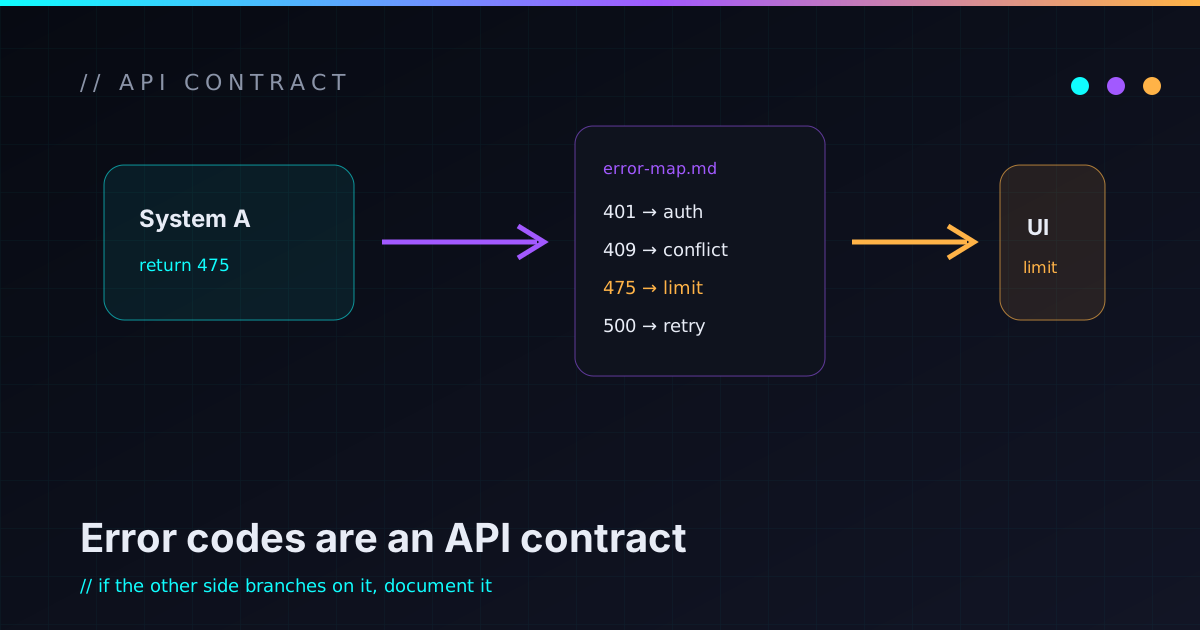
I spent a while mapping how one system told another why a request failed — a backend handed a web front-end a numeric code, and the front-end turned that code into a user-facing message and an HTTP status. It was a perfectly ordinary integration, and it taught me something I now treat as a rule: those codes are an API contract, every bit as much as a documented REST endpoint. The trouble was, nobody treated them like one, so the contract lived entirely in the receiver’s head — as a lookup table the sender had never seen.
A status code that crosses a boundary is an interface
When system A returns a code and system B branches on it, the set of codes and their meanings is the interface between them. “Code 475 means too many active devices” is an API guarantee in exactly the way a JSON field name or an endpoint path is. Both sides depend on it. Change it on one side without the other and something breaks — silently, because the wire format still looks valid.
We’re trained to treat the obvious surfaces — endpoints, payloads, schemas — as contracts that need versioning and care. Status and error codes sneak under that radar because they feel like incidental detail, “just the error number.” But the receiver is making decisions on them. Anything one system decides behavior on, based on another system’s output, is an interface. Treat it like one or it’ll bite like one.
If the other side branches on it, it’s an API. The fact that it’s “just a number” doesn’t make it less of a contract — it makes it an undocumented one.
The smell: meaning that lives on only one side
What struck me was where the meaning of those codes actually lived: in a constants file inside the receiver. The front-end had painstakingly enumerated dozens of numeric codes and mapped each to a message and an HTTP status. The backend that emitted the codes had — as far as anyone could tell — no shared, authoritative list of what they meant. The contract existed, but only one party held a copy, and they’d reverse-engineered it.
That’s a fragile arrangement. The sender can introduce a new code, or quietly repurpose an old one, and the receiver won’t know until an unmapped code shows up in production and falls through to a generic “something went wrong.” The meaning of an interface should be shared and authoritative, not folklore reconstructed by whoever consumes it. When only the receiver knows what the codes mean, the sender can break the contract without ever realizing there was one.
Always handle the unknown code
The one genuinely good defensive move already in place: a default case. The receiver pulled the numeric code off the response, looked it up, and if it didn’t recognize the code, fell back to a generic failure rather than crashing or showing garbage. That’s the right instinct, and it generalizes to every code-driven integration.
You will eventually receive a code you don’t have a mapping for — because the other side added one, because of a version skew, because of a typo upstream. The question is only whether your code degrades gracefully or falls over. A default branch that produces a safe, generic outcome is the difference between “a new code shows up and users see a polite error” and “a new code shows up and the page explodes.” Map what you know; survive what you don’t. Never assume the set of codes you handle today is the set you’ll receive tomorrow.
Group the codes so the mapping is legible
Mapping dozens of individual numbers one by one is how the table got unwieldy and how subtle inconsistencies crept in — two codes that should mean the same thing mapped to different messages, that kind of drift. The thing that made it tractable was noticing the codes clustered into a handful of categories: invalid credentials, rate limiting, lifecycle/expiry, entitlement, server-side failure.
Once you see the families, the mapping becomes legible and consistent — you map categories to behaviors and slot each code into its family, instead of treating every number as a unique snowflake. It also exposes the gaps: when you lay them out by category, the missing and the miscategorized ones jump out. Structure turns a flat list of magic numbers into something you can reason about and review.
How I treat code contracts now
The habits I took away from that mapping exercise:
- Document the codes as an interface, in a place both sides can see — authoritative, shared, versioned. Not as a comment in the receiver, not as tribal knowledge.
- Own the meaning on the sender’s side too. The system emitting the codes should hold the canonical definition; the receiver consumes it, doesn’t reinvent it.
- Always implement a default. Unknown codes are inevitable; graceful degradation is a choice you make in advance.
- Group by category so the mapping is reviewable and inconsistencies surface.
- Treat adding or changing a code as an API change, with the same care you’d give renaming a field — because that’s exactly what it is.
It’s a humble corner of integration work, and it’s where a startling amount of “why is the user seeing a generic error” actually lives. The error codes flowing between your systems are an API. Write them down, own them on both ends, and never trust that today’s set is the whole set. If you’ve reverse-engineered a neighbor system’s status codes and lived to tell about it, I’d love to swap stories.