Infrastructure / Security
LabPrivate Cloud / Homelab
Private-cloud experiments with Docker, VMware, PKI, networking, monitoring, and zero-trust patterns.
- Docker
- VMware
- PKI
- Zero Trust
- Self Hosting
- Monitoring
- Infrastructure
What this proves
Proves I understand messy, self-operated infrastructure — failure modes, trust boundaries, and recovery included — not just tidy diagrams or toy examples.
Overview
The Private Cloud / Homelab project is where I test infrastructure ideas before they become opinions. It’s a practical environment for learning how systems behave when you have to design them, deploy them, secure them, monitor them, and recover them yourself — with no managed service quietly papering over the hard parts.
It’s a learning and validation lab, not a public cloud provider or a commercial hosting claim. What makes it valuable is exactly that you operate the consequences: the lab is where patterns earn their place before they show up in independent consulting — including earlier work like Duvall WiFi — or in a product build like NexusPort.
Why build a private cloud
You learn infrastructure by operating it, not just by diagramming it:
- Learning through operation — owning the whole stack means owning the failures, which is where the real lessons live.
- Understanding failure modes that managed platforms abstract away.
- Validating patterns before recommending them — taste you can stand behind because you’ve felt the tradeoffs.
- Building intuition for tradeoffs between reliability, maintainability, security, recovery, and complexity.
- Keeping curiosity tied to real systems instead of slideware.
This isn’t an “I replaced the cloud” story. It’s a place to build judgment.
Architecture themes
The lab is organized around the same principles I’d want in any serious system, kept deliberately high-level here:
- Modular services with clear separation of concerns.
- Network boundaries that make trust explicit rather than assumed.
- Identity and trust treated as first-class design inputs.
- Repeatable deployment, so rebuilding is routine, not heroic.
- Recovery planning — assuming things break and designing for the rebuild.
- Documentation that keeps the whole thing understandable over time.
Containers and virtualization
Two tools, used for different jobs:
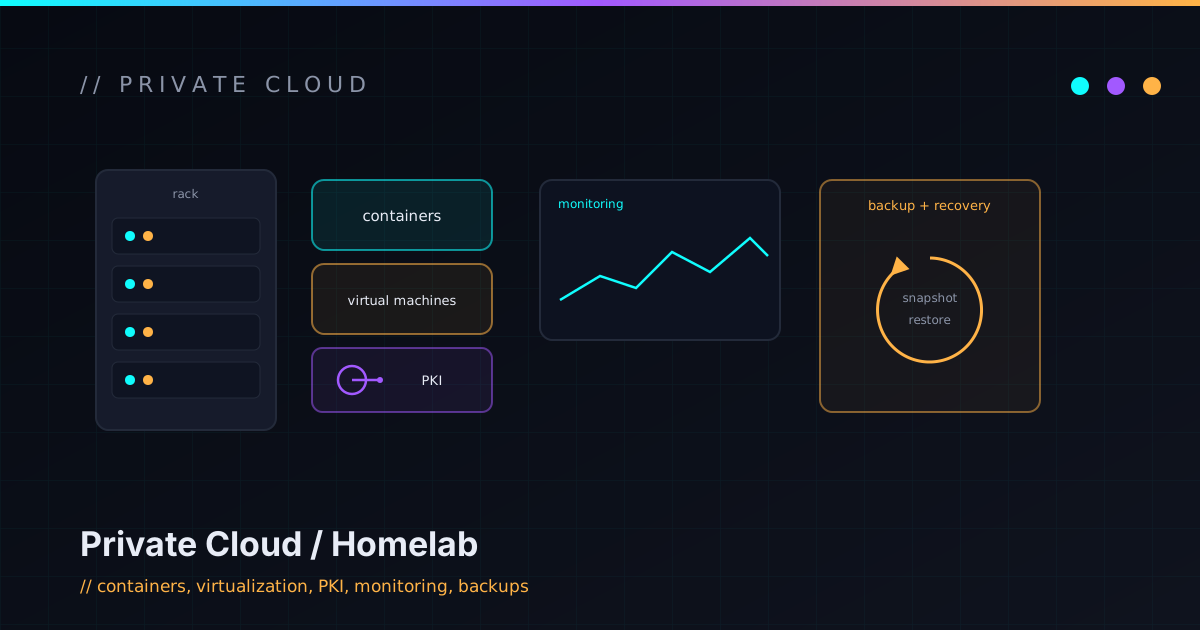
- Docker for repeatable, disposable services — packaging deployment so the same thing comes up the same way every time, which keeps environment drift from creeping in.
- Virtualization (VMware) for isolation and multi-system lab environments, where having a full, separable machine is the right unit.
- When containers win: stateless-ish services, fast iteration, clean teardown.
- When VMs still make sense: stronger isolation, OS-level experiments, and scenarios where a whole-machine boundary is the point.
The goal is simple, repeatable deployment patterns — not the most exotic setup.
Security and trust boundaries
Internal services still get treated as real systems. Convenience is not a reason to lower the bar:
- Least privilege by default — access is granted narrowly and on purpose.
- Segmentation to reduce blast radius when something does go wrong.
- Certificate trust / PKI as a design concept — building and operating the trust boundaries yourself makes them far easier to reason about.
- Reducing attack surface through careful, deliberate exposure.
- Secrets stay out of docs and repos — full stop.
This is principle, not implementation: no private addresses, hostnames, keys, or access methods belong on a public page like this one.
Observability and operations
A lab you can’t see into is just a pile of surprises:
- Logs and monitoring so behavior is visible, not guessed at.
- Alerts that point at the real problem instead of the symptom.
- Backups and recovery drills — a backup you’ve never restored is a rumor.
- Knowing what changed, so an incident starts from facts.
- Operational documentation that makes the safe path the easy path.
What the lab teaches
This is the part that pays off in professional work:
- Operating a system teaches better architecture than only designing one.
- Complexity has a carrying cost — every clever addition is something to operate later.
- Clean rollback paths matter more than clever forward paths.
- A lab is a place to safely break things and learn, on purpose.
- Private infrastructure sharpens consulting judgment — you advise differently when you’ve lived with the consequences.
What I learned
- Boring reliability is a feature, not a lack of ambition.
- Secure defaults save a lot of future pain.
- Automation should reduce risk, not hide it — a hidden process is a future incident.
- Documentation is part of operations, not an afterthought to them.
- The best lab systems are the ones still understandable after you haven’t touched them for weeks. (More of that mindset in notes from a private cloud gremlin.)
What’s next
Honest, directional next steps:
- More standardized service templates.
- Cleaner documentation and runbooks.
- A stronger, well-tested backup and recovery model.
- Deeper monitoring that explains why, not just that.
- Improved secrets handling.
- More portable container patterns.
- Public-safe architecture diagrams, once they can be shared without exposing anything sensitive.
If infrastructure, security, or homelab-flavored problem-solving is your kind of thing, let’s compare notes.
Related writing
The companion essay, Notes From a Private Cloud Gremlin, goes deeper on the lab mindset: why operating your own systems teaches better architecture than only designing them on paper.
Where to next
Keep exploring
A few good next steps from here — a related build, some background reading, or a way to take it further together.