Systems Thinking
A Silent Fallback Is Worse Than a Crash
When a system hits something it can't handle, falling back to a different working-looking state is more dangerous than failing loudly — because the only signal that anything went wrong is the one it just swallowed.
- Systems Thinking
- Reliability
- Networking
- Debugging
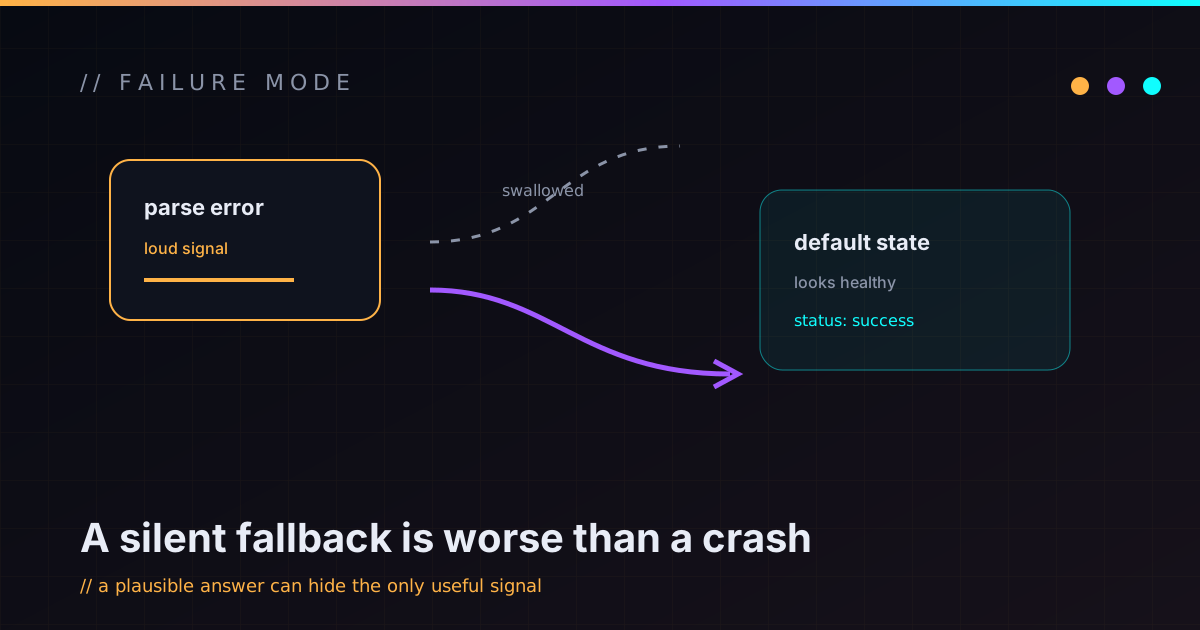
I once spent the better part of two days chasing a host that came up on the wrong network configuration. I’d handed it a static address in its boot metadata; it ignored that and self-assigned a different one off the router instead. Nothing errored. The machine booted, I could log into it, the provisioning tool reported success. It was just quietly wrong, in a way that took far longer to find than a clean failure ever would have. The root cause turned out to be a lesson I keep relearning: a silent fallback to a plausible-looking state is one of the most expensive failure modes you can design into a system.
The bug hid inside a “helpful” default
The mechanism was almost comically specific, and that’s what makes it a good story. The boot configuration was a small structured document — a bit of YAML describing the network. One field in it listed DNS servers as an inline list, and one of those servers was an IPv6 address full of colons. An older parser on the guest choked on the colons inside that inline list, decided the value was malformed, and — here’s the fatal part — threw away the entire document, not just the one bad field.
With no configuration document left, the boot process fell back to its default behavior: “no instructions, so just grab whatever the network offers.” The host SLAAC’d an address off the router advertisement and carried on as if that had been the plan all along. One unparseable value in one field silently discarded every other instruction in the file.
The danger wasn’t the parse error. It was that the parse error had a fallback waiting to catch it and make everything look fine.
”Fail open” feels kind and acts cruel
There’s a design instinct behind this, and it’s a sympathetic one: don’t let a small mistake brick the machine. If the config is bad, do something reasonable rather than refuse to boot. That’s “fail open,” and in plenty of contexts it’s the right call.
But fail-open has a cost that fail-closed doesn’t: it converts a loud, immediate, locatable error into a quiet, deferred, anywhere error. A box that refuses to boot tells you exactly when and roughly where it broke. A box that boots onto the wrong network tells you nothing — you find out later, somewhere else, when a service can’t reach it or it answers on an address you never assigned. The kindness of the fallback is exactly what makes the eventual debugging so cruel.
What made it nearly invisible: a masking case
The detail that cost me the most time is the one worth internalizing. The same setup worked perfectly in another configuration. When the host had a dual-stack setup, its DNS list contained an IPv4 address with no colons — which parsed fine — so the document loaded and the static config applied exactly as intended. The bug only appeared in the IPv6-only case, where the DNS entries were all colons.
So the failure wasn’t “the parser is broken.” It was “the parser is broken for one shape of input that happens to coincide with one specific deployment mode.” Every other path masked it. That’s the signature of the hardest bugs: a working majority case sitting right next to a broken edge case, with nothing flagging the difference. When something works “almost everywhere,” the almost is where the truth is hiding.
Diagnose the discard, not the symptom
The symptom screamed “networking” — wrong address, DNS not applying. The cause had nothing to do with networking; it was a YAML parse failure three layers up that ate the whole document. I burned hours treating the symptom because the real event left almost no trace.
It left almost no trace. The thing that finally cracked it was reading the boot logs closely enough to notice a single line admitting the config had been discarded and a default substituted. That line was the entire story, and it was one entry buried in a wall of routine output. The takeaways I pulled out of it:
- Hunt for the silent substitution. When behavior doesn’t match configuration, stop tuning the configuration and ask whether it was loaded at all. A “using fallback / using default” log line is a confession; go find it.
- Verify the live state against intent. Reading back the actual running value — the address the box really has, not the one you told it to take — turns an invisible failure into a visible one. (Same instinct as reading the live kernel value instead of trusting the file you wrote.)
- Test the edge shape, not just the common one. The dual-stack case passing proved nothing about the IPv6-only case. Exercise the input that’s different, not the input that’s typical.
Build things that fail loud
The fix, once found, was trivial: render the config so the problematic value wasn’t in a shape the parser mishandled. But the durable lesson is about design, not that one file. When I build something now that has to make sense of input or config, I try to make the failure mode honest:
- Prefer failing closed for anything that defines correctness. If the network config, the security policy, or the data mapping can’t be understood, stopping with a clear error beats proceeding with a guess. A box that won’t boot is a better Tuesday than a box that booted wrong.
- Never let one bad field silently void the whole document. Reject the field, name it, and keep the rest — or refuse the lot and say so. Don’t quietly swallow everything and substitute a default.
- Make fallbacks loud when you do want them. A fallback isn’t evil, but it must announce itself at the top of the logs, not whisper from the middle. “I could not use your config, so I’m doing X instead” is a sentence the operator needs to read.
A crash is a system telling you the truth at the worst possible moment, which is still the best possible moment to hear it. A silent fallback is a system telling you a comfortable lie that you’ll pay for later, with interest. Given the choice, I’ll take the crash. If you’ve got your own “it booted, it just booted wrong” war story, I’d genuinely like to hear it — these are the bugs that make you a better engineer precisely because they’re so annoying to find.