Build Notes
FeaturedBuilding Weird Ideas Into Real Systems
A note on turning chaotic ideas into scoped, shippable systems without sanding off the fun parts.
- Product Thinking
- Systems
- Architecture
- Creativity
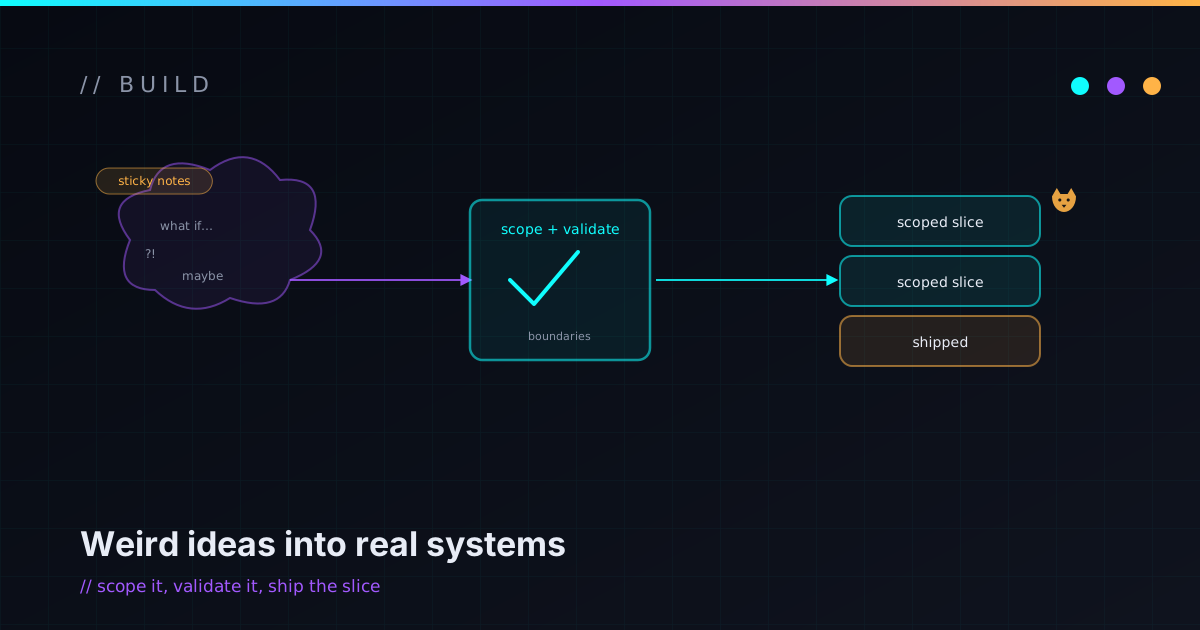
Most things I’m proud of started as a sentence that sounded faintly ridiculous out loud. “What if the port-change workflow was a product?” “What if a set could tag its own tracks by energy?” “What if the Discord bot just… did the annoying part for everyone?” None of those were serious plans. They were weird ideas. This is roughly how I turn weird ideas into systems that actually run — without grinding the weirdness out of them on the way.
The weird idea is allowed to exist
The first rule is the easiest one to break: let the strange idea live before you judge it. A weird idea is usually just a problem nobody has standardized yet, which means there’s room to build something that fits instead of something off the shelf.
The failure mode is killing the weirdness early to make the idea sound “professional.” You round off the interesting edges, and what’s left is a sensible, forgettable version of someone else’s product. Keep the strange parts in the notebook. They’re usually where the value is hiding — and they’re definitely where the motivation is.
To be clear, the weirdness is not the problem. Unscoped is the problem. A weird idea and an unbounded idea feel the same at 1am, but they are not the same thing, and the rest of this post is mostly about telling them apart.
Make the first version real
Ideas are cheap until they run. The fastest way to learn whether a weird idea is any good is to build the smallest version that actually does the thing — end to end, in the real world, even if it’s ugly.
Shipping a rough thing teaches you more than polishing a perfect plan.
Real means it runs, takes a real input, and produces a real output. Not a mock, not a deck, not a Figma frame you nod at. A thing. The first real version is allowed to be embarrassing. Its only job is to convert your assumptions into feedback, and it does that whether it’s pretty or not.
Scope is not the enemy
Scope has a bad reputation among people who like ideas, because it feels like the moment the fun gets confiscated. It isn’t. Scope is what lets the idea survive long enough to become real.
The trick is to scope down, not out. I’m not cutting the weird core — I’m cutting everything orbiting it that I don’t need to learn the next thing. The question I keep asking is, “What is the smallest version that still tells me whether this is worth building?” That version almost always fits in a weekend, and the leftover ambition goes into a list instead of into the first build.
A few habits that keep scope honest:
- Write down the one thing the first version has to prove.
- Park every “and also” in a someday list so it stops nagging.
- Treat “we could eventually…” as a feature, not a requirement.
Architecture is how chaos survives reality
Here’s the tension at the center of all of this: creative ideas are chaotic, but systems that last are disciplined. Architecture is the bridge between the two. Small modules, clear boundaries, and honest interfaces let you keep moving fast without the whole thing collapsing under its own cleverness.
The habits I lean on are boring on purpose:
- Keep files and components small and single-purpose.
- Make data the source of truth, not values scattered and hardcoded everywhere.
- Decide what’s a boundary early, and then actually respect it.
Boundaries are what let the chaotic part stay chaotic. If the messy, exploratory code lives behind a clean interface, you can rip it out and rewrite it three times without the rest of the system noticing. Architecture isn’t the opposite of play — it’s the container that makes play safe.
Keep the fun parts
The reason to do any of this is that it’s enjoyable. If the process grinds the joy out of the idea, the idea dies in a backlog with all the others. So I deliberately protect the fun: a playful name, a satisfying interaction, a small flourish that has no business being there and earns its place anyway.
This is strategy disguised as indulgence. The flourish you kept is the reason you open the editor again tomorrow, and tomorrow is when most projects are actually won or lost. Sustainable momentum needs a little chaos and a lot of curiosity.
Proof in the projects
This isn’t a theory I admire from a distance — it’s how the work on this site actually got made.
- NexusPort started as “what if a fiddly, timing- sensitive network workflow were a real product?” The weird framing survived; the scope got disciplined around intent, validation, and reviewable change.
- Creative tech experiments are the fun-first ideas on purpose — playful, a little chaotic — but still built with real structure underneath instead of disposable one-offs.
- Community bots are small, single-purpose systems that automate the annoying parts of a server so the humans can get back to the part they came for.
Different domains, same operating system: let the idea be weird, make a real first version, scope hard, give it a clean spine, keep the joy.
What I’m building next
More of the same, honestly. Take a strange idea, scope it down to something real, give it a clean architecture, and protect the parts that make me want to keep going. If you want the longer version of how I think about all this, there’s more on the about page — and if you’ve got a weird idea of your own that’s ready to become a real system, that’s literally the Weird Idea to Real System service — come tell me about it.