Infrastructure
Homelabs Teach the Messy Parts
A homelab hands you the operational failures that polished cloud dashboards quietly handle for you — and those messy parts are exactly the lessons worth having.
- Homelab
- Infrastructure
- Operations
- Networking
- DNS
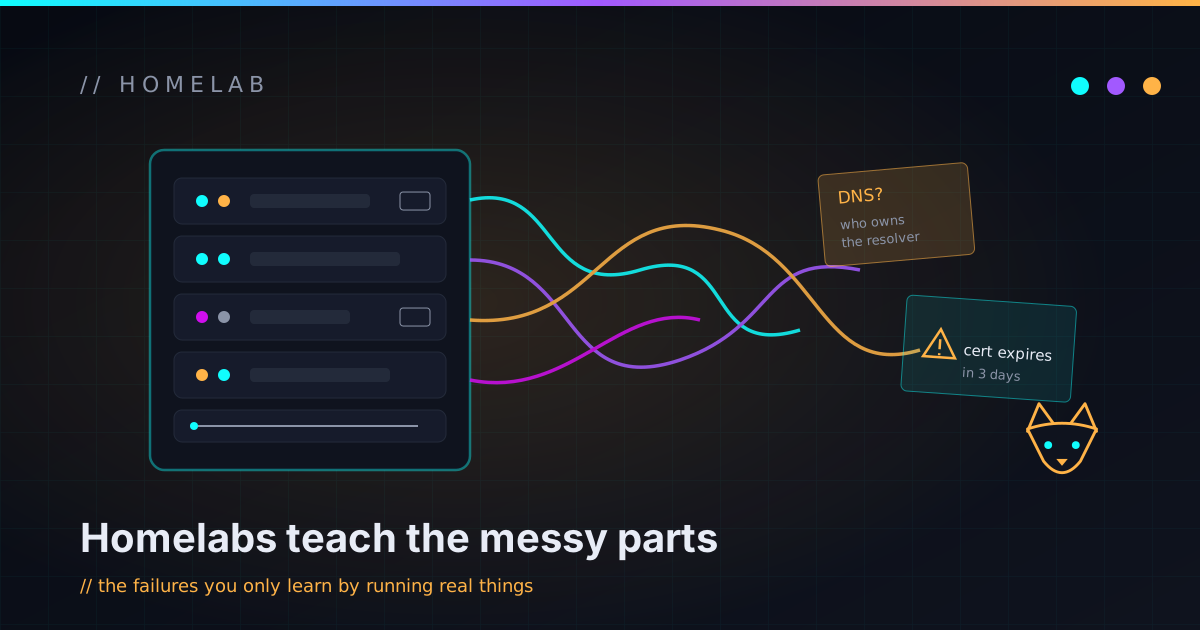
Managed cloud is wonderful, and part of why it’s wonderful is that it hides the mess. The dashboard says green, the disk that’s failing gets swapped before you notice, the certificate renews itself, the DNS just works. A homelab takes all of that back and hands it to you personally, usually at an inconvenient hour. That’s not the bug — it’s the entire curriculum. The polished version teaches you to trust the green light; the messy version teaches you what the green light is actually standing on.
This is the concrete companion to my private cloud gremlin notes, which is more about the philosophy. This one is about the specific things that break.
Hardware fails in boring, humbling ways
Cloud abstracts hardware so thoroughly you forget it exists. The lab reminds you. Drives develop bad sectors. A fan dies and a node starts thermal-throttling for no reason you can see in software. RAM goes flaky and corrupts things intermittently, which is the worst way for anything to fail. SD cards — let’s not.
The lesson isn’t “buy better hardware.” It’s assume hardware fails and design so that when it does, the failure is contained and recoverable instead of mysterious. That assumption is free in the lab and very expensive to learn for the first time in production.
Certificates expire at the worst possible time
Everyone understands TLS in theory until they’ve watched a cert expire on a Sunday and take a handful of internal services down with it. The lab teaches the lifecycle: issuing, renewing, trusting an internal CA, what breaks when a chain is incomplete, why a service that pins or caches a cert keeps failing after you “fixed” it.
A certificate you have to remember to renew is an outage with a calendar invite.
Automating renewal — and actually testing that the automation works before you need it — is one of those skills that looks invisible right up until it saves a weekend.
DNS is always the answer (and the problem)
There’s a reason “it’s always DNS” is a tired joke: it’s tired because it’s true. Running your own resolver, split-horizon views, internal versus external names, and caches that serve you a stale record long after you fixed the real one — the lab makes you fluent in the failure mode that takes down a surprising fraction of real outages.
Once you’ve spent an evening convinced a service is broken when actually a resolver was handing you a ghost, you start checking DNS first, everywhere, for the rest of your career. That instinct is worth the evening.
Backups are a restore you haven’t tested yet
It’s easy to feel responsible because a backup job reports success every night. The lab disabuses you of that fast. A backup is a claim; a restore is the proof. The first time you actually try to recover — and discover the backup was missing a volume, or the restore path needs a service that’s also down, or the encryption key lives only on the box you’re restoring — is the moment backups stop being theater.
An untested backup is a rumor. A tested restore is a plan.
So in the lab I treat the restore as the real deliverable, and the backup as just the thing that enables it. Same discipline that shows up in the private cloud case study.
Monitoring is how you find out before your users do
Without monitoring, your alerting system is “someone complains.” The lab teaches the difference between that a thing broke and why — between a dashboard full of pretty graphs nobody reads and a handful of signals that actually page you when something matters. You learn what’s worth watching by watching the wrong things first, missing a real failure, and adjusting.
The goal isn’t maximum observability; it’s useful observability — enough to catch the failure early and explain it later, without drowning in noise that trains you to ignore alerts.
Weird networking is a rite of passage
VLANs that don’t route the way you swore they would. An MTU mismatch that only breaks large packets, so half your traffic works and the confusing half doesn’t. A NAT hairpin. Two things fighting over the same subnet. Firewall rules that are correct individually and contradictory together. The lab is a generator of networking problems that are genuinely strange, and chasing them down builds a mental model no tutorial delivers.
This is the same muscle that earlier networking and consulting work leaned on — “it works on the bench” and “it survives a real site” are very different claims, and the lab is where you learn to tell them apart.
Why this makes better software engineers
You can write software for years and treat infrastructure as a wall you throw artifacts over. The lab knocks the wall down. Once you’ve felt how systems actually fail — hardware, certs, DNS, restores, networking — you write different code: code that assumes failure, degrades gracefully, logs what operators will need, and doesn’t quietly depend on the happy path always holding.
That’s the real return on a shelf of blinking lights. Not the services it runs — the judgment it builds. If you’re running your own and want to trade war stories, my inbox is open; if your stack could use a second set of eyes, that’s an Infrastructure Sanity Pass; and if you want to see where this shows up in real work, start on the work page.