Automation
Automation Needs a Panic Button
Automation is only trustworthy when a human can understand it, audit it, pause it, and recover from it. Dry runs, logs, rollback, and a manual override are the price of trust.
- Automation
- Operations
- Reliability
- AI
- Least Privilege
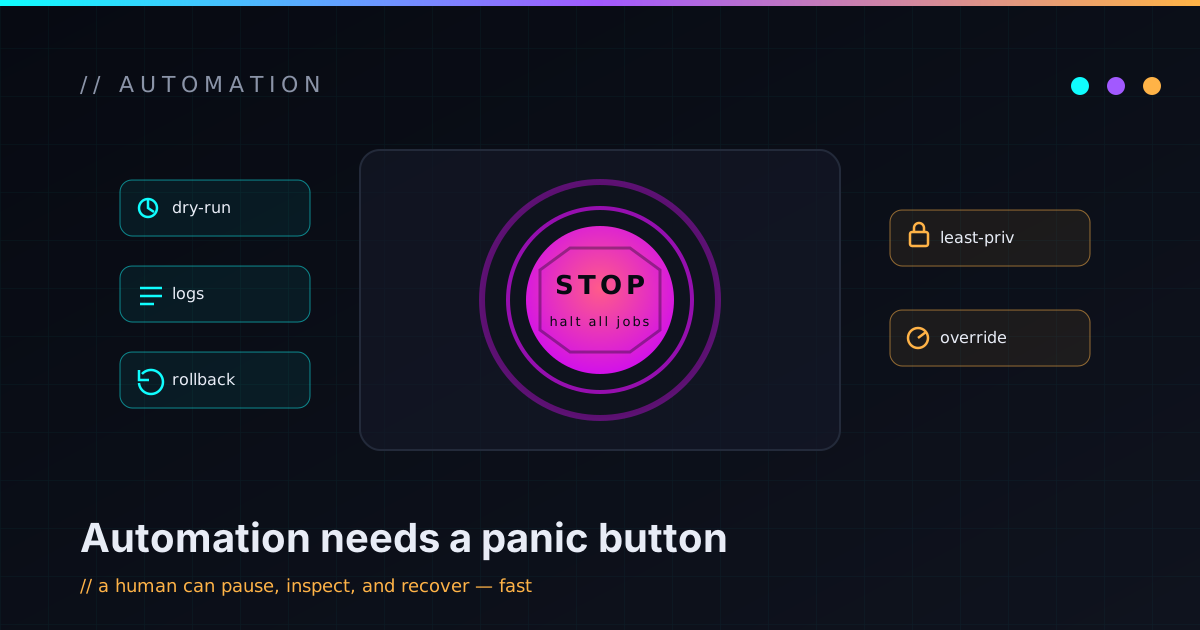
Automation is a promise: “I’ll do this correctly every time so you don’t have to.” The trouble is that automation keeps the promise enthusiastically whether it’s right or wrong. A script that does the correct thing 1,000 times a day will do the wrong thing 1,000 times a day with exactly the same confidence. So the question isn’t “does it work?” — it’s “when it goes wrong, can a human understand it, stop it, and undo it?” If the answer is no, you don’t have automation. You have a fast way to make a big mess.
The fix is unglamorous: build the off-ramps before you build the engine. A panic button isn’t an admission the automation is bad. It’s the thing that makes trusting it reasonable.
Dry runs first, always
The cheapest safety feature in automation is a mode that shows you what would happen without doing it. A good dry run prints the full plan — every file it’d touch, every record it’d change, every command it’d run — and then stops.
Trust is earned in dry runs and spent in real ones.
I don’t enable an automation against anything that matters until its dry run output has been boring and correct several times in a row. If the tool can’t tell me what it’s about to do, it has no business doing it unattended.
Logs are the automation’s conscience
Unattended work has to leave a trail, because by definition nobody was watching. Good logs answer the questions you’ll actually ask at 1am: what ran, when, with what inputs, what it decided, and what it changed. Not a wall of debug noise — a legible record of decisions and effects.
This is the same idea as treating documentation as infrastructure: the system has to explain itself to the human who shows up later with none of the context. An automation that acts silently is one you can only debug by re-running it and hoping, which is exactly when automation turns scary.
Rollback is a feature, not an apology
Any automation that changes state needs a way back. That can be transactional (“apply all of it or none of it”), versioned (“here’s the previous state, restore it”), or reversible-by-design (“every action has a defined undo”). What it can’t be is hope.
The test I hold automation to: if this does the wrong thing on run #500, how do I get back to where I was — and how long does that take? If the honest answer is “I don’t know” or “I’d reconstruct it by hand,” the rollback path is the feature that’s missing, not a nice-to-have for later.
Manual override is the panic button
There has to be a way for a human to say stop and have the system actually stop — a kill switch, a pause flag, a feature toggle, a queue you can drain. Automation without an override assumes it will never be wrong in a way you didn’t anticipate, and that assumption has never once held.
The override has to be reachable under stress, too. A panic button buried behind the very system that’s currently on fire isn’t a panic button. The whole point is that a tired human at the worst moment can find it and trust it.
Least privilege keeps the blast radius small
Automation runs without a human in the loop, which makes its permissions the ceiling on how much damage a bug can do. So it gets the narrowest access that lets it do its job and nothing more — scoped tokens, write access only where it genuinely writes, no standing god-mode “to be safe.”
This is the same least-privilege posture that matters everywhere, but it bites harder here: a human with too much access might pause before doing something dumb. A script won’t. Narrow permissions are what keep a runaway automation a small story instead of a long one.
No silent magic
The failure mode I trust least is automation that’s clever — that infers intent, papers over errors, and quietly “fixes” things without telling anyone. Silent magic feels great right up until it silently does the wrong thing, and now you’re debugging a system that actively hid its own behavior from you.
Predictable and boring beats clever and quiet, every single time.
Good automation is legible: it does what it says, says what it did, and fails loudly instead of guessing. I’d rather have a tool that stops and asks than one that confidently improvises.
When the automation is AI
All of this gets more important the moment an AI agent is the thing acting, not less. An agent is automation that can also be confidently wrong in novel, creative ways — so it needs every guardrail above and then some: a dry-run / proposal step before anything lands, logs of what it decided and why, a tight permission scope, and a human approval gate on the actions that actually matter.
That’s the whole design behind the AI automation lab and the small-slices workflow: let the agent move fast inside a fence, and keep the panic button in human hands. The same restraint shows up in the community bots — small, single-purpose, easy to reason about, easy to switch off.
Automation is leverage, and leverage cuts both ways. The dry runs, logs, rollback paths, and override aren’t friction slowing the automation down — they’re what make it safe to let go of the wheel at all. Build the panic button first. Turning one dreaded manual workflow into something safe and repeatable is the whole point of an Automation Sprint — and if you’d rather just compare notes on doing this without summoning a haunted house of cron jobs, I’m easy to reach.