Systems Thinking
Containers Rehearse the Logic, VMs Rehearse the Risk
When I needed to rehearse a risky database migration, containers were the fast, cheap way to debug the logic — but the parts that could actually hurt in production only exist on a real VM, so the honest answer was to use both.
- Systems Thinking
- Containers
- Docker
- Infrastructure
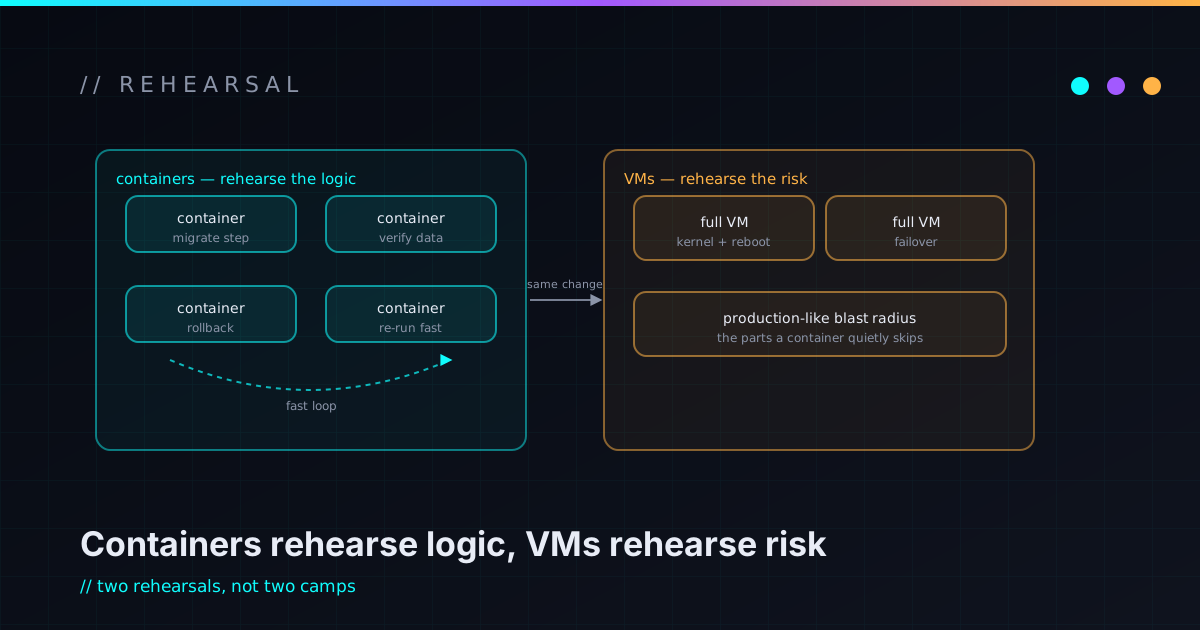
I needed to rehearse a risky migration on a multi-node database cluster before running it for real — the kind of change where a mistake on live data ruins your month. The obvious question was “containers or VMs?” The better question, which took me a beat to get to, was “what am I actually trying to de-risk?” Because containers and VMs don’t rehearse the same thing. Containers rehearse the logic. VMs rehearse the risk.
Containers are a fantastic logic harness
Most of the procedure was declarative: schema changes, replication settings, where data should live. That kind of work runs anywhere the database runs. So a handful of containers on a private network, wired into a couple of logical groups, gave me a faithful enough cluster to exercise the logic of the change in minutes — and tear it down and re-seed it just as fast.
That speed is the point. Fast, disposable, repeatable environments are where you want to iterate: shake out the ordering bugs, confirm the data lands where you expect, run it a hundred times in CI. For the parts of a procedure that are really just commands and data, containers are hard to beat on cost and cycle time.
The risk lives exactly where containers cheat
But the dangerous part of this migration wasn’t the logic. It was the operational mechanics around it: a rolling restart of the service on nodes that already held data, some host-level kernel tuning the database wants, the real login path operators would use, and — most importantly — a rollback I could actually trust if it went sideways.
Containers paper over every one of those. They don’t run a real init system by default, so a “restart the service” step isn’t exercising what production does. Kernel and memory tuning is host-global, not per-container, so you can’t really rehearse it inside one. The remote-access path isn’t there. And the rollback mechanism is different from the one you’d use on a VM. You can force a container to imitate all of this — but by the time you’ve built a privileged, init-running, VM-shaped container, you’ve spent the cost savings that made containers attractive in the first place.
A container that has to imitate a VM in every way that matters is just a slower way to build a VM.
So use both, on purpose
The resolution wasn’t to pick a winner. It was to let each tool do the job it’s good at:
- Containers as the fast functional harness — debug the logic, run it repeatedly, use it as a CI smoke test of the change.
- A real VM environment as the faithful sign-off, where the risky mechanics (rolling restart on populated nodes, the real kernel, the real access path, the validated rollback) actually execute before you trust the procedure on production.
They’re complementary, not competing. The cheap harness makes the expensive rehearsal faster and safer by catching the logic bugs before you ever touch a VM. Match the environment to the specific thing you’re trying to de-risk, and you stop overpaying for fidelity you don’t need while still getting it where you do.
A bonus lesson: equivalent, not identical
The other thing this clarified: I didn’t need a copy of production. I needed an environment that started in the same well-defined state. Those are different, and the difference matters. Rebuilding the environment from a recipe — the same provisioning automation plus the real schema definition and synthetic data — gets you a faithful starting point with none of the baggage. Exporting production to get there is the worst option: it drags real credentials and personal data into a test environment you then have to scrub, and that kind of cross-environment export is usually blocked at the source anyway.
An equivalent you can rebuild from scratch beats a copy you had to smuggle out, every time.
The payoff was a real bug, caught cheap
The proof it was worth it: the container harness caught an actual bug in the production procedure. A node that already held data refused to restart after its topology label changed, unless a specific override flag was set for that one transitional boot. On a container that cost me a thirty-second retry. On a live node, mid-change, it would have been a stuck restart and a tense rollback.
That’s the entire return on the cheap harness — surfacing the expensive surprise where it’s harmless. It’s the same instinct as the operational realities a homelab teaches you and the rigor of treating a benchmark rig as part of the experiment: know what you’re actually testing. If you’re planning a hairy migration and want to talk through how to rehearse it, I’m easy to reach.